
Weather Compensation Systems: Why Your Heating Could Be Using More Energy Than Necessary
The real problem is not always how much heating a building needs. It is how intelligently the heating system responds to that demand.
Many heating systems operate at unnecessarily high water temperatures, even when outdoor conditions are relatively mild. Weather compensation addresses this by automatically adjusting the heating system’s flow temperature according to outdoor conditions.
However, installing weather compensation does not automatically guarantee lower energy bills. The performance depends on how the heating system is designed, configured, commissioned and maintained.
1. What is really happening
Traditional heating controls often operate around a relatively simple principle: when the indoor temperature drops below the thermostat setting, the heating system starts supplying heat.
The problem is that a conventional boiler may deliver water at the same high temperature whether it is freezing outside or relatively mild.
Weather compensation introduces a more intelligent control strategy.
Instead of maintaining a fixed heating flow temperature, the controller adjusts the target water temperature according to outdoor conditions and a programmed heating curve.
Illustrative weather compensation response
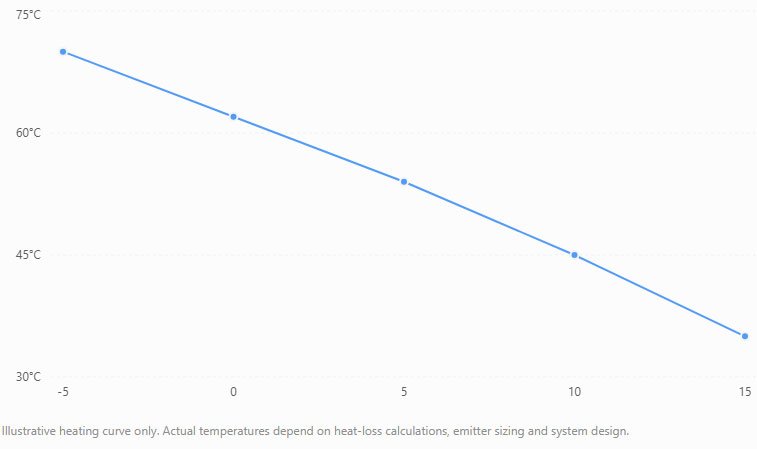
When the outside temperature increases, the target heating water temperature reduces. When the weather becomes colder, the controller increases it to compensate for greater building heat loss.
This helps the heating system match the building’s actual heat demand rather than repeatedly supplying excessive heat.
2. Why this problem occurs
Most buildings experience changing heat losses throughout the day and across the seasons.
Heat escapes through walls, roofs, glazing, floors and ventilation. As the difference between indoor and outdoor temperatures increases, heat loss generally increases too.
However, heating systems are often configured conservatively, with high flow temperatures intended to satisfy demand on the coldest days.
Consequently, a system designed to cope with freezing winter conditions may continue operating at unnecessarily high temperatures throughout autumn and spring.
For a modern condensing boiler, this can reduce efficiency because higher return-water temperatures limit the amount of heat recovered through condensation.
It can also contribute to room-temperature overshoot and unnecessary cycling.
Weather compensation addresses the mismatch between heating output temperature and outdoor conditions. It does not, by itself, fix poor insulation, inadequate radiators, hydraulic problems or faulty controls.
3. Common mistakes
Mistake 1 — Believing the heating must constantly switch off to save energy.
A correctly configured modulating heating system may operate for longer periods at lower output and lower water temperatures. This can be more efficient than repeatedly heating water to unnecessarily high temperatures and shutting down.
Longer operation does not necessarily mean greater energy consumption. Equally, continuous operation is not automatically the most efficient strategy.
Mistake 2 — Assuming installing an outdoor sensor is sufficient.
The sensor provides information, but the heating curve determines how the system responds. An incorrectly configured curve can produce overheating, poor comfort or inadequate heating during cold weather.
Mistake 3 — Treating weather compensation as a replacement for all room controls.
Weather compensation mainly adjusts water temperature. Room thermostats, thermostatic radiator valves, zoning and scheduling still have important roles, depending on the control design.
Mistake 4 — Ignoring radiator and system performance.
Poorly balanced radiators, restricted circulation, sludge, trapped air and incorrectly configured pumps can undermine the benefits of lower flow temperatures.
Mistake 5 — Confusing space heating with domestic hot water.
Reducing radiator heating temperatures is different from managing domestic hot-water storage and distribution. Hot-water hygiene and scalding protection requirements must be considered separately.
4. What matters most
There are four technical priorities.
The system must provide sufficient heat during the coldest design conditions without unnecessarily high temperatures during milder weather.
Hydraulic and emitter performance
Radiators, pumps, valves and flow rates must work correctly across the intended temperature range.
Control compatibility and coordination
Boiler modulation, room controls, weather sensors, heating schedules and any building management system must operate together rather than issue conflicting instructions.
Measured performance
Evaluate indoor comfort, flow and return temperatures, system cycling and weather-adjusted energy consumption, not simply whether the radiators feel hot.
5. What the customer should do next
Before investing in new controls, establish how the existing heating system operates.
Check compatibility. Confirm whether the boiler or heat pump supports weather compensation and which manufacturer-approved controllers are suitable.
Review the current settings. Identify the existing flow-temperature setpoint, heating schedules, thermostat arrangement and any relevant faults.
Check system condition. Review radiator balancing, circulation, valves and maintenance history.
Commission the heating curve properly. A competent heating-controls specialist should configure it for the building’s heat losses and heating emitters.
Monitor the results. Record internal temperatures, heat-source operation and energy use through representative weather conditions. Adjust the curve gradually if the building overheats or cannot maintain comfort.
The objective should be to achieve the lowest practical heating-water temperature that still maintains the required indoor conditions, not simply to minimise the temperature setting.
6. One expert insight most competitors overlook
Boiler operating hours are not the same as energy consumption.
This distinction is especially important for communal heating systems and larger buildings.
Residents or property managers may observe that a heating system operates for long periods and conclude that it is wasting energy. They may then repeatedly switch it on and off to reduce running time.
But heating efficiency cannot be assessed from running hours alone.
A modulating boiler operating at low output, with suitable flow and return temperatures, can consume less energy than a system operating for shorter periods at high output. Conversely, poorly controlled continuous operation can waste substantial energy through distribution losses, overheating or unnecessary heat generation.
A weather-compensated system should therefore be assessed using three separate measures:
Comfort: Are the occupied spaces maintaining the required temperatures?
Efficiency: Is heat being generated and distributed efficiently, with unnecessary losses and cycling minimised?
Consumption: How much fuel or electricity is actually being used relative to weather and occupancy?
For communal plant, an additional distinction is essential: pumps may circulate water continuously without boilers firing continuously at full output.
A heating engineer should establish what is actually running, why it is running and how much energy it consumes before recommending changes.
The strongest improvement is often not replacing the boiler or installing additional controls. It is correctly commissioning, coordinating and optimising the equipment already installed.